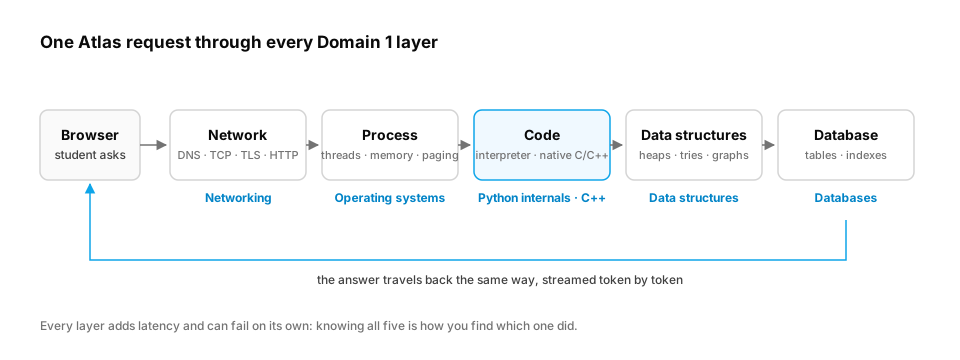
What Atlas can do now
| Lesson | Atlas gained |
|---|---|
| Python internals | Runs as a Python service; heavy work goes to packed arrays |
| C++ & memory | Knows where data lives and why layout decides speed |
| Data structures | Finds sessions in O(1), schedules requests with a heap, reuses shared prompt prefixes |
| Operating systems | Runs many workers safely; manages memory in pages |
| Networking | Answers over HTTPS, streams tokens, retries safely, rate-limits |
| Databases | Remembers progress and payments safely, with indexes and transactions |
The problem Atlas can't solve yet
Ask Atlas: "Is GPU memory the same as VRAM?"
It can store both phrases, index them and fetch them in microseconds — but it can't tell that they mean nearly the same thing. A database index answers "is this string equal to that string?" Understanding needs "is this similar to that?"
Computers only compare numbers. So we need a way to turn meaning into numbers, and then measure closeness between them.
The idea that opens Domain 2
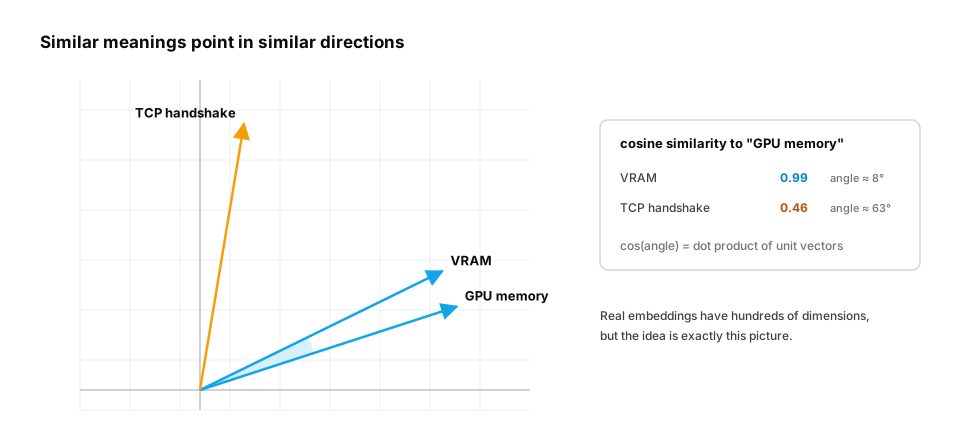
Describe each phrase with a list of scores — say, how much it's about hardware, about storage, about speed:
import numpy as np

phrases = {
    "GPU memory":   np.array([0.9, 0.8, 0.3]),
    "VRAM":         np.array([0.9, 0.9, 0.2]),
    "TCP handshake": np.array([0.2, 0.0, 0.6]),
}

def similarity(a, b):
    return float(a @ b / (np.linalg.norm(a) * np.linalg.norm(b)))   # cosine similarity

q = phrases["GPU memory"]
for name, vec in phrases.items():
    print(f"{name:14s} {similarity(q, vec):.2f}")
# GPU memory 1.00, VRAM 0.99, TCP handshake 0.46
That list of scores is a vector. Similar meanings get vectors pointing in similar directions, and one multiply-and-add operation — the dot product — measures how aligned they are. Real models learn vectors with hundreds or thousands of scores automatically instead of us choosing three by hand.
Where Domain 2 takes us
- Linear algebra — vectors, matrices and dot products: the language of embeddings and attention.
- Calculus — how a model measures "how wrong" and which way to adjust.
- Probability & statistics — reasoning about uncertainty and evaluating models honestly.
- Optimization — the algorithms (SGD, Adam) that actually do the adjusting.
- Information theory — entropy and cross-entropy: the loss every LLM is trained on.
You'll keep using Domain 1 throughout: vectors are the packed NumPy arrays from Python internals, and their memory layout is exactly why GPUs (D13) are so good at this maths.
Next: D2 · Linear algebra →