You already know: eigenvectors of symmetric matrices, rank and conditioning (Linear systems and eigenvectors); covariance (Probability).
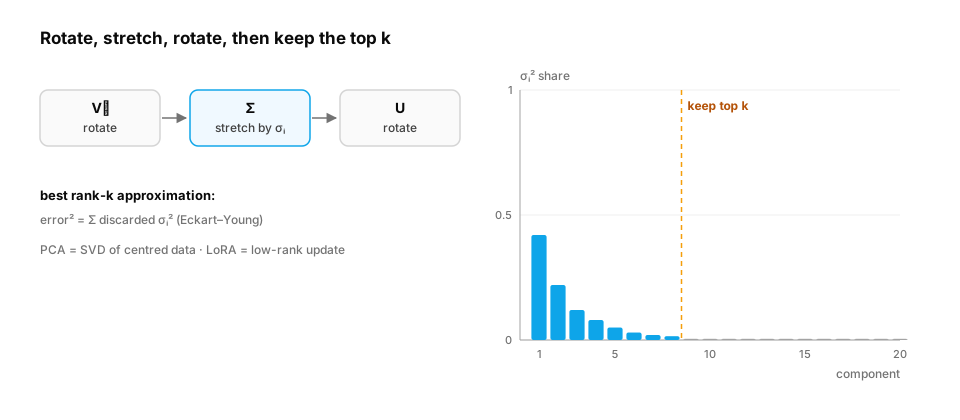
Why this matters for Atlas. The singular value decomposition factors any matrix into rotations and a stretch, and sorts its "directions of action" by importance. Truncating it gives the best low-rank approximation of a matrix, the mathematical basis of PCA (dimensionality reduction), LoRA (low-rank fine-tuning updates, D6), embedding compression, recommendation by matrix factorization, and many interpretability analyses. This lesson builds SVD and PCA and measures what truncation keeps.
1. The decomposition
The question. What does a matrix do to space, in the simplest possible terms?
Start from nothing. Any m×n matrix A factors as A = UΣVᵀ, where V (n×n) and U (m×m) have orthonormal columns (rotations/reflections) and Σ is diagonal with non-negative singular values σ₁ ≥ σ₂ ≥ … ≥ 0. Applying A means: rotate the input into V's basis, stretch axis i by σᵢ, rotate into U's basis. The number of non-zero singular values is the rank; σ₁/σ_min is the condition number; and the singular values are the square roots of the eigenvalues of AᵀA, linking SVD to the previous lesson.