You already know: vectors, distances and SVD/low rank (Linear algebra §2, §6); supervised learning needs labelled examples (Supervised learning §1).
Why this matters for Atlas. Labels are expensive: someone has to read every student question to tag its topic. Unsupervised learning finds groups, directions and outliers in raw data — so we can discover "these 400 questions are all about CUDA memory errors", compress features, and spot weird traffic. It's also the conceptual root of embeddings and vector search (D8).
1. Clustering with k-means
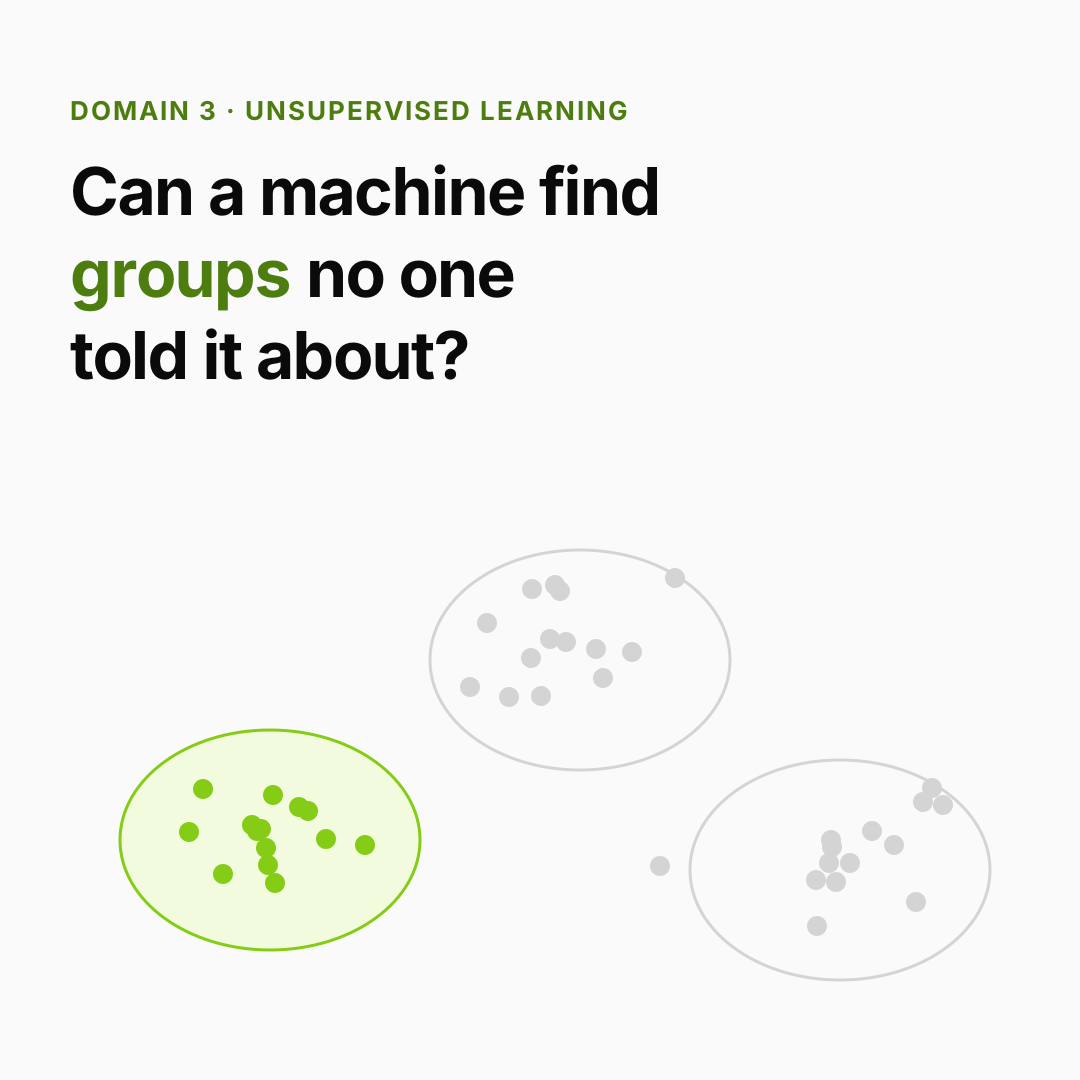
The question. How can a computer group similar questions without being told the groups?
Start from nothing. k-means looks for k group centres (centroids) so that each point is close to its centre: