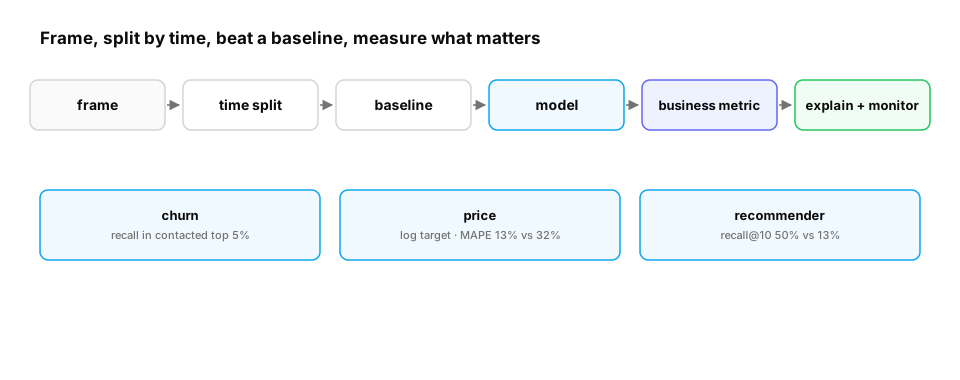
You already know: the whole classical ML domain: supervised and unsupervised learning, feature engineering, evaluation, boosting, tuning, imbalance and SHAP.
Why this matters for Atlas. Knowing algorithms isn't the same as delivering a model that helps. The gap is in the decisions around the algorithm: what exactly to predict and when, how to split data so the evaluation means something, which baseline to beat, which metric reflects the business goal, and how to explain and monitor the result. These three compact projects practise that loop on the three most common problem shapes (classification, regression, ranking), and the last section collects the questions interviewers ask about them.
1. Project 1: churn prediction
The question. Which active students will stop using Atlas in the next 30 days, so the success team can reach out to the riskiest 5% each week?
Start from nothing. Frame: binary classification at a weekly prediction time; label = no activity in the following 30 days; features only from before the prediction time (SQL for ML). Split by time: train on earlier weeks, validate and test on later weeks, never random rows (a student's future weeks would leak into training). Baseline: "days since last activity" alone. Metric: the team can contact 5% of students, so measure recall at the top 5% (what fraction of churners are in the contacted group) and precision there, not AUC alone.