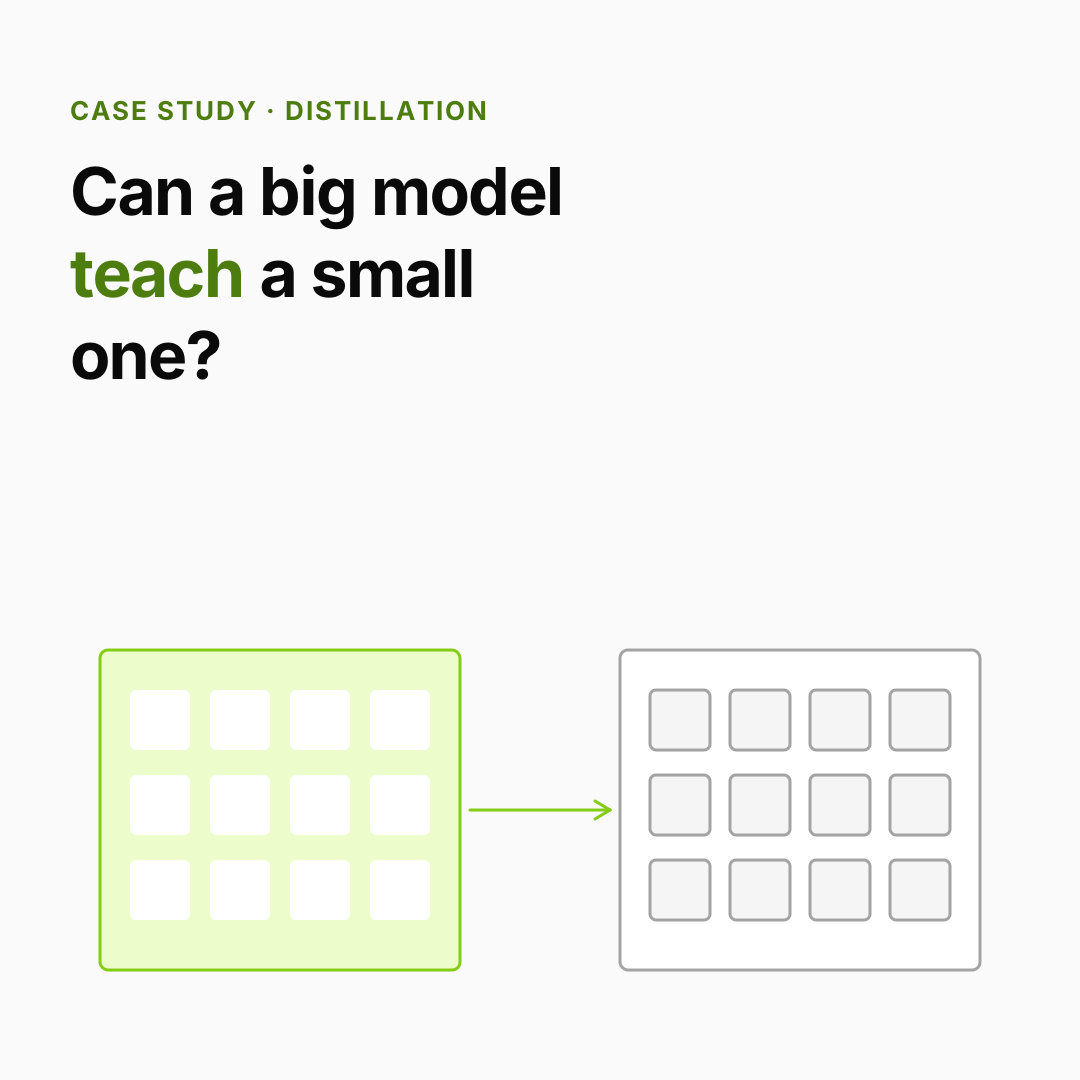
You already know: fine-tuning, evaluation gates, the semantic router and LLM serving costs. This case designs a distillation pipeline: a large teacher model generates training data, and a small student model is fine-tuned on it to do a specific task at a fraction of the cost. The design questions: where the prompts come from, how to filter the teacher's mistakes, how to evaluate the student honestly, and how to serve it safely when it is unsure.
How to read this lesson. No code, on purpose. Numbers marked assumed are assumptions you state out loud; prices are illustrative.
1. The prompt, and the questions that change the design
A mid-level answer: "generate a million examples with the big model, fine-tune a small one, swap it in". A staff candidate notes that training is the cheap part: the risk and cost sit in prompt coverage (the student only learns what the prompts show it), filtering (the teacher's mistakes become the student's habits), honest evaluation (on real held-out traffic, per slice, with no overlap with training data) and serving (what happens when the student meets something new). They also ask a question others skip: do the teacher's terms allow training on its outputs?
Assumptions you state: