You already know: retrieval, chunking and hybrid search (D8.1–D8.4); query rewriting, reranking and multi-step retrieval (D8.5); embeddings and vector databases (D8.2, D8.4).
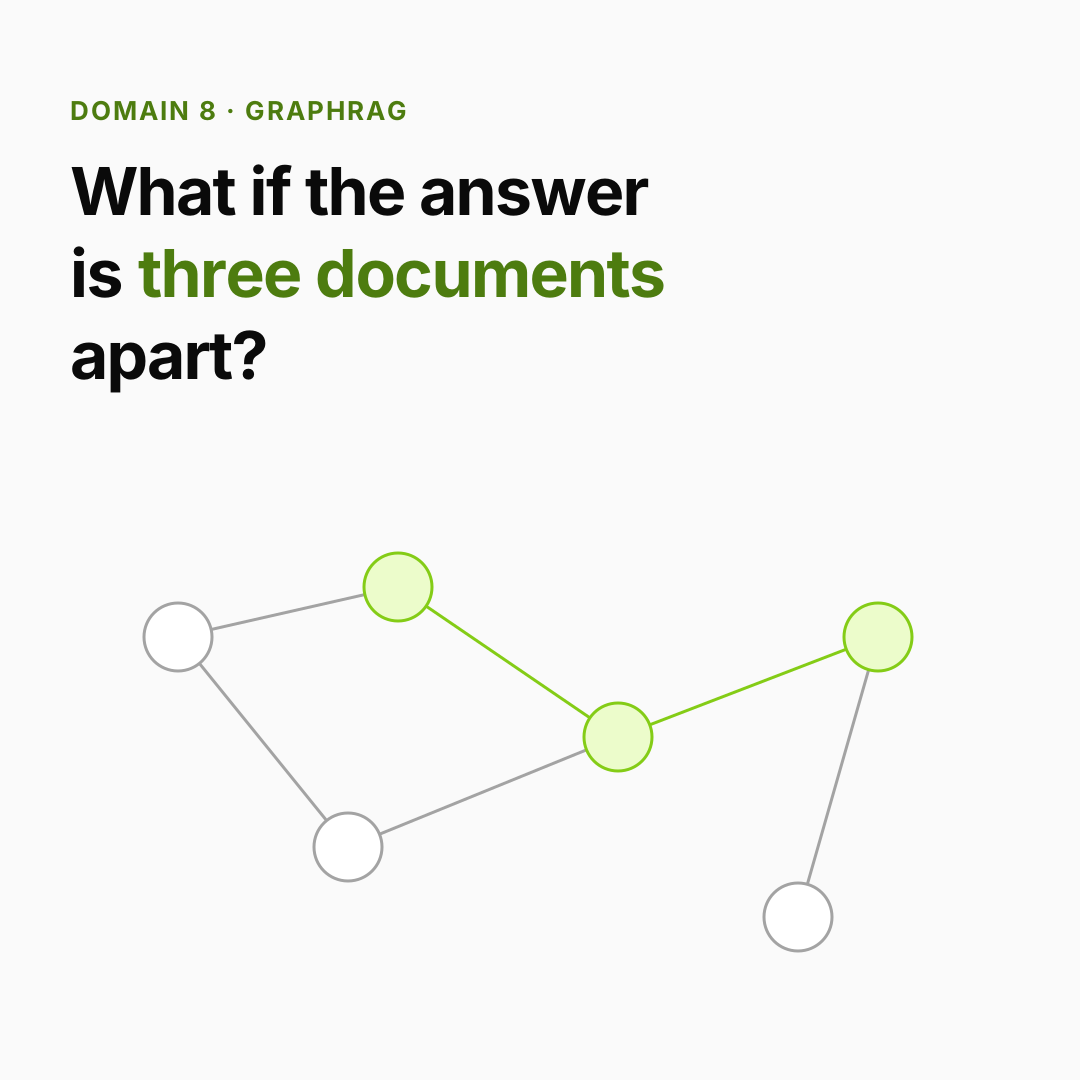
Why this matters for Atlas. Vector RAG finds the chunks that look like the question. That's perfect when one chunk holds the answer and fails in two common cases: when the answer is spread across documents connected by shared entities (multi-hop), and when the question is about the whole collection (global). GraphRAG adds a structure built at indexing time, a graph of entities and their relations, so retrieval can follow connections and summarise communities instead of guessing which five chunks matter. It costs real money to build, so the skill is knowing when it pays.
1. Where chunk retrieval breaks
The question. What kinds of questions can top-k chunk retrieval not answer, however good the embeddings?
Start from nothing. Top-k retrieval returns the k chunks most similar to the question. Two question shapes defeat it: