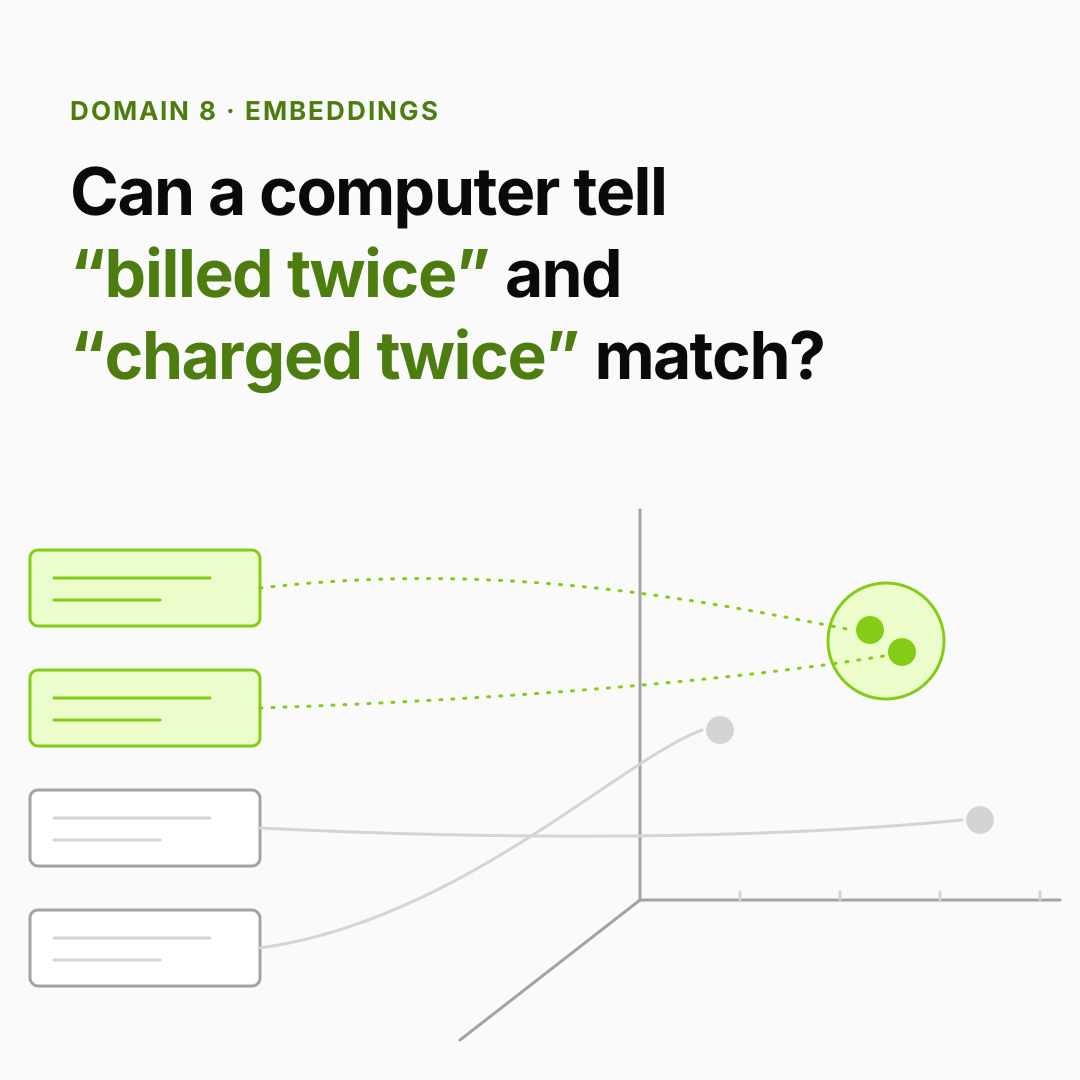
You already know: vectors, dot products, SVD (D2 Linear algebra); embeddings as lookup tables and co-occurrence + SVD (D5 NLP foundations); cross-entropy and contrastive objectives (D4); the vocabulary-mismatch problem (Retrieval fundamentals §4).
Why this matters for Atlas. An embedding maps text to a vector so that texts with similar meaning land close together. That one idea fixes BM25's biggest weakness, powers semantic search and recommendations, and underlies every vector database. Choosing, using and operating embeddings well is a large share of RAG engineering: which model, which similarity measure, how many dimensions, how to compress them, and what happens when you upgrade the model. This lesson covers each one with measurements.
1. Meaning from company: dense retrieval
The question. How can a computer know that "billed" and "charged" mean nearly the same thing?
Start from nothing. "You shall know a word by the company it keeps" (Firth, 1957). Words used in the same contexts tend to mean similar things. If "billed" and "charged" keep appearing near "twice", "card" and "payment", a method that compresses co-occurrence patterns will give them similar vectors. You built the simplest version in D5: count co-occurrences, then factorize with SVD. Applied to documents, this is latent semantic analysis (LSA).