You already know: detection, NMS, IoU and mAP (Computer vision); CNNs and their cost (CNNs from scratch); quantization formats and calibration (D12 Quantization).
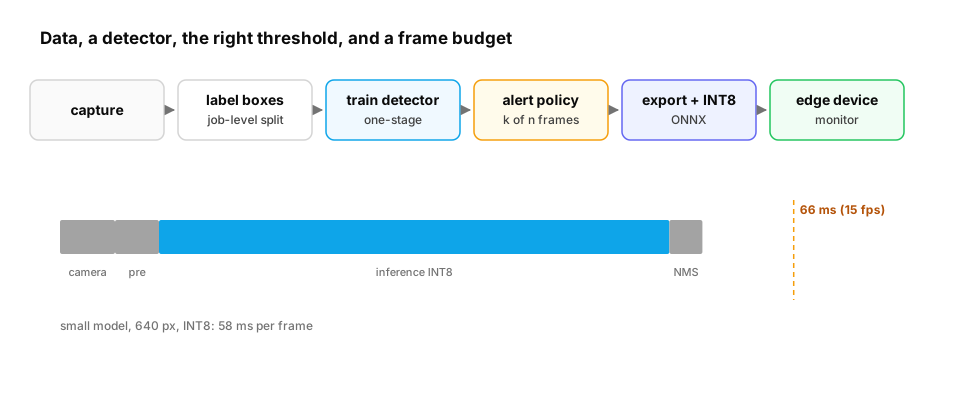
Why this matters for Atlas. Most real computer vision is narrow, specific and runs close to the camera: inspecting parts, counting items, spotting failures. Success depends less on the newest architecture than on data (rare defects, lighting changes), on an evaluation that reflects what an error costs (a missed failure wastes a 10-hour print; a false alarm interrupts an operator), and on fitting a latency and memory budget on cheap hardware. This lesson walks one project end to end: data and labels, a one-stage detector (the YOLO family), evaluation and thresholding, and edge deployment with export, quantization and a real-time loop.
1. Data and labels: the real work
The question. Where do the training images for rare defects come from?
Start from nothing. Defects are rare, so collect deliberately: run prints until they fail, include the conditions the camera will really see (lighting, angles, filament colours, dust on the lens), and label with bounding boxes per defect class ("spaghetti", "layer shift", "detached corner"). Measure label quality: have two people label a sample and compute their box agreement (IoU) and class agreement; inconsistent labels cap the model's achievable mAP. Split by print job, not by frame, because frames from the same print are near-duplicates (the same leakage as splitting churn data by row). Augment with what changes in deployment (brightness, blur, small rotations), not with transformations that can't happen.