You already know: how a prompt becomes a request and how structured output works (D7 Prompt fundamentals); how the context window is a budget (D7 Context engineering); multi-hop retrieval, where one search depends on another (D8 Advanced RAG); and the gap the D8 bridge left: three of eight student requests need actions, not answers.
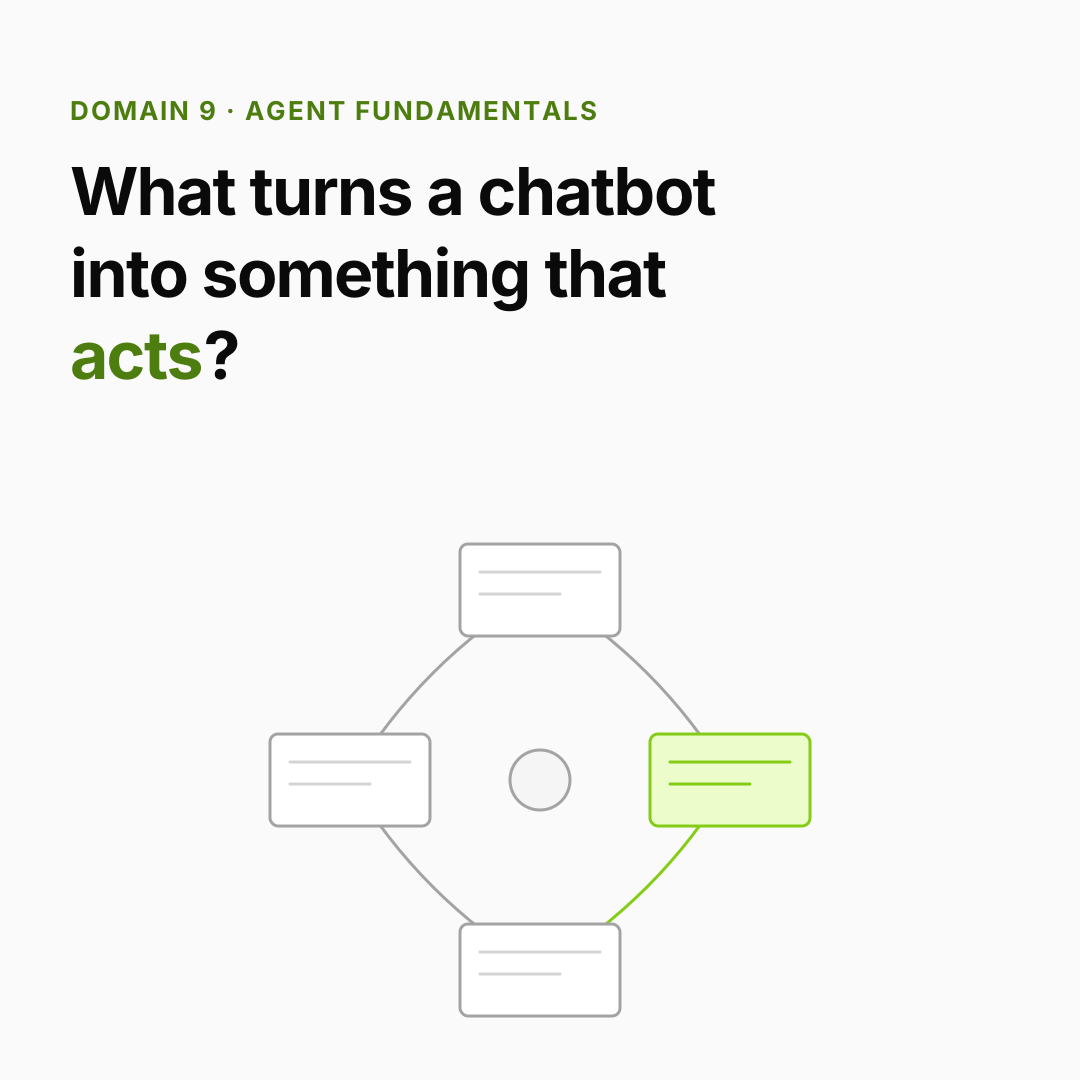
Why this matters for Atlas. An agent is a model running inside a loop: it chooses an action, your code executes it, the result goes back into the context, and the model chooses again until the task is done. That one loop is behind coding assistants, research assistants and support bots that issue refunds. It's also where most production failures come from: runaway loops, wrong arguments, context that grows until each step costs a fortune, and actions that can't be undone. This lesson builds the loop from scratch, measures what it costs, and gives you the rule for when not to use one.
1. The loop: decide, act, observe
The question. What is the smallest piece of code that turns a model into an agent?
Start from nothing. A plain model call is a function: text in, text out. To act, the model needs three things your code supplies: