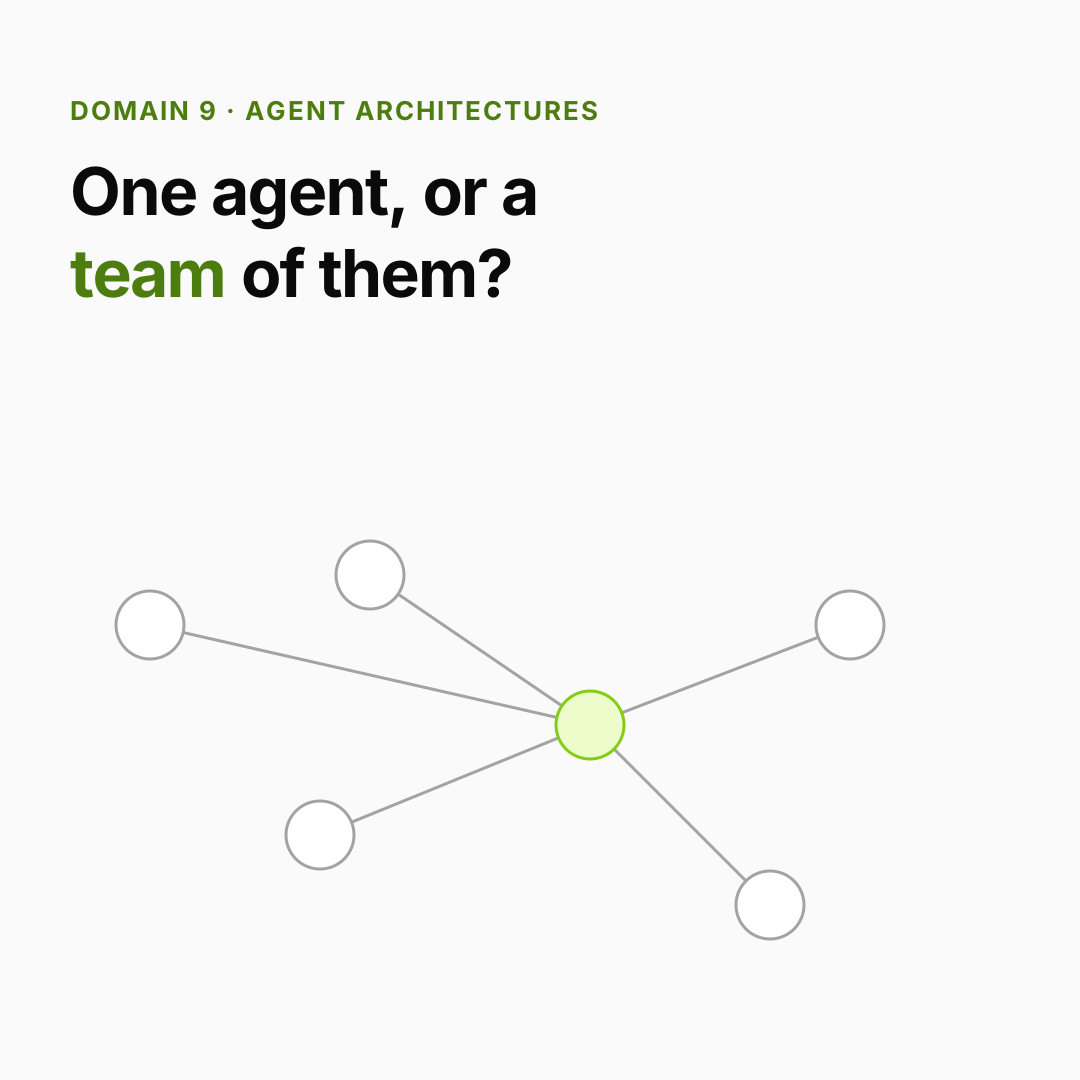
You already know: the agent loop, its guards and its cost (Agent fundamentals); prompt chaining and self-consistency (D7 Advanced prompting); graphs and topological order (D1 Data structures).
Why this matters for Atlas. "Agent" isn't one design. It's a family of patterns that arrange the same loop differently: a router sends each request to the right specialist, a planner writes the steps before acting, a critic checks work before it ships, a supervisor splits work across workers. Each pattern buys something (cost, parallelism, accuracy, isolation) and pays for it in latency, tokens or complexity. Interviewers ask "how would you structure this agent?" precisely because the right answer depends on the trade-off. This lesson builds each pattern, measures what it buys, and ends with a rule for choosing.
1. Routers: send each request to the right specialist
The question. Most Atlas requests are simple lesson questions. Why pay for the full agent on every one of them?
Start from nothing. A router is a cheap first step that classifies the request and dispatches it: to a single RAG call, to the quiz agent, to the billing agent, or to a human. Each specialist gets a short prompt and only its own tools, which makes it faster, cheaper and more accurate than one agent that knows everything. The router itself can be rules, a small classifier (D3), or a small model.