This page builds the code. The ideas behind it are taught in the Library lessons listed at the end; read them first if a step uses something you haven't met. Inspect and copy the complete code in the Atlas Codebase Browser and run each step as you read.
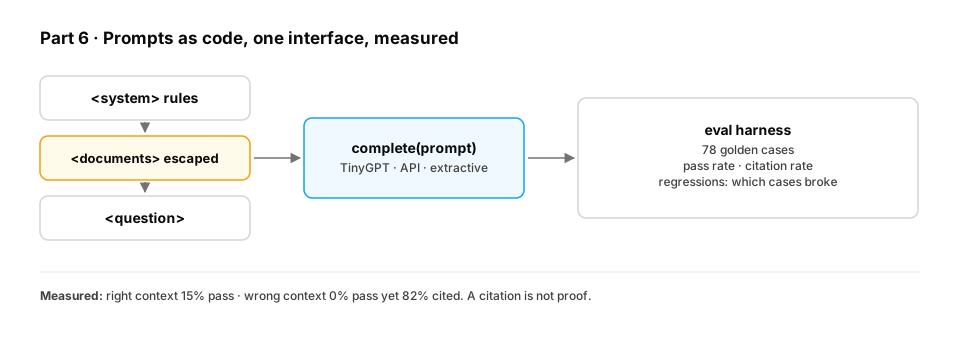
From here on, Atlas is a system, not just a model. This part builds three pieces every LLM application needs. A prompt builder that assembles instructions, documents and the question in a fixed order, and treats documents as untrusted. A model interface small enough that TinyGPT, a hosted API or a test fake can all sit behind it. And an evaluation harness that turns "it seems better" into a pass rate and a list of exactly which cases broke.
Diagram— system rules, escaped documents and the question are assembled into one prompt; any model behind a single complete(prompt) method answers; the eval harness scores answers against golden cases and reports pass rate, citation rate and regressions.
Step 1 · Prompts are code
The prompt is built by a function, never by hand-editing strings. Stable rules come first (so a provider can cache them), then the per-request documents, then the question. Every document gets an id, so the model can cite it as [1].
That's the preview. Build Atlas Parts 1 and 2 are free; the full walkthrough of Part 6 is part of Unrolled Pro.
Staff AI & Pro Tier Lesson
Unlock "Build Atlas, Part 6: Talk to it well"
The foundations are free forever. Unrolled Pro unlocks the complete lesson, production architectures, and 55 battle-tested ML system design case studies.
Everything included with Pro:
All 234+ Deep-Dive Lessons across transformer internals, inference, RAG & agents
55 Staff-Level ML & System Design Case Studies with mathematical capacity estimates
AI Engineer Sheet & Exercises with worked solutions, self-checks, and code
100 Landmark Research Papers guided walkthroughs & progress tracking
14-Day Money-Back Guarantee — 100% full refund if you aren't satisfied