You already know: the roofline, MFU and MBU (D12 Inference fundamentals, Measurement & capacity); latency hiding with resident warps (GPU architecture); coalescing, reuse and bank conflicts (GPU memory hierarchy); reductions and tiling (Parallel computation); CPU profiling (D1 Profiling).
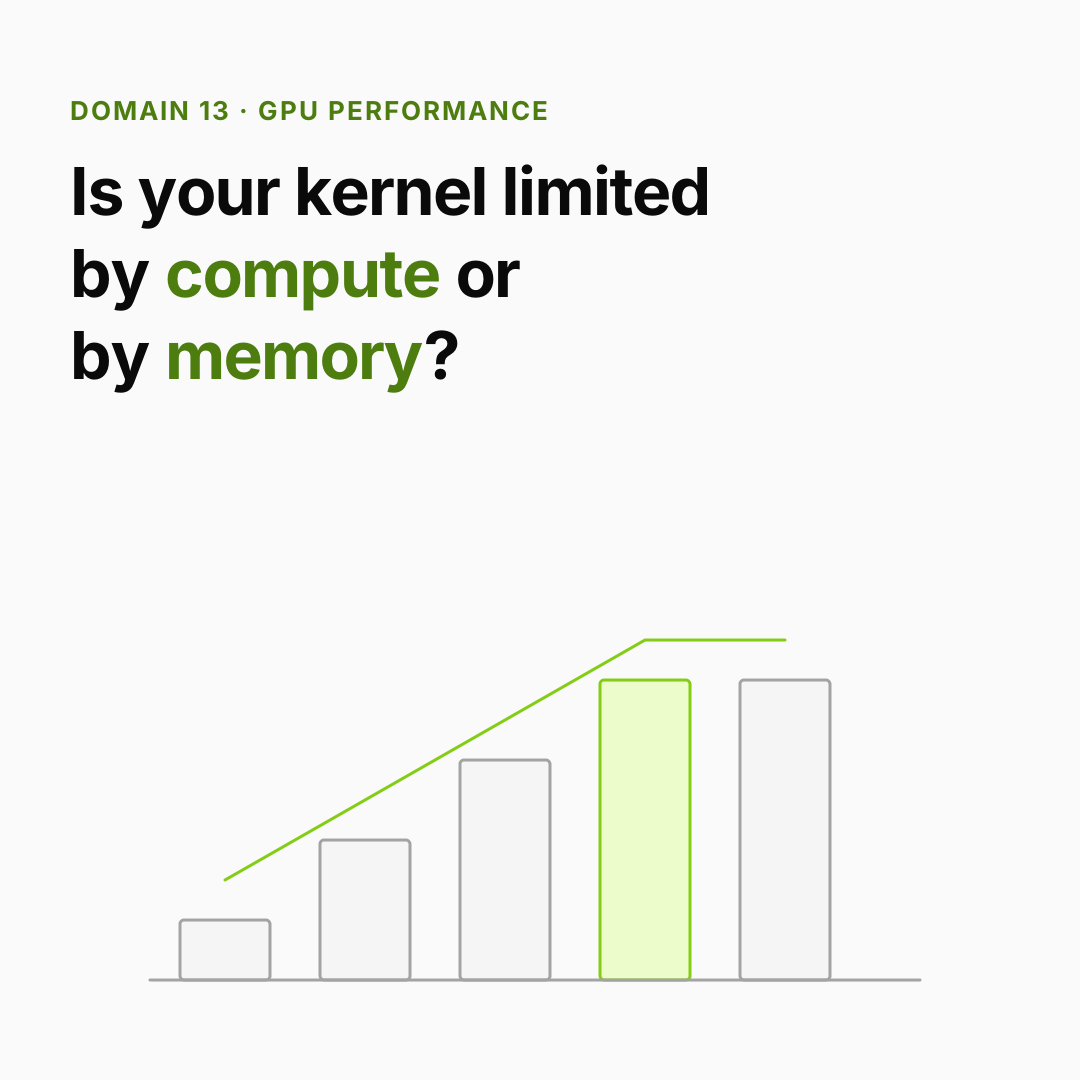
Why this matters for Atlas. Performance work without measurement is guessing, and GPU guesses are usually wrong because there are three different ways to be slow: memory-bound (not enough bytes per second), compute-bound (not enough FLOPs per second), and latency/overhead-bound (the GPU waits: launch gaps, too few warps to hide latency, synchronization, CPU stalls). Each has a different fix, and the fix for one makes the others worse or does nothing. This lesson gives you the method: classify the kernel on the roofline, compute occupancy, read a profile, and apply the right optimization, with a benchmark methodology that produces numbers you can trust.
1. Classify before you optimize
The question. The kernel is slow. Which of the three bottlenecks is it?
Start from nothing. Measure two things for the kernel: achieved bytes/s from global memory and achieved FLOP/s, then compare each with the hardware peak: