VFlash: Fast, Accurate Visual Planning via Flash Primitive Decoding
u_Unrolled
D11: Production ML Systems · Capstone: An End-to-End ML Platform — From Raw Events to Monitored, Self-Refreshing Models

Capstone: An End-to-End ML Platform — From Raw Events to Monitored, Self-Refreshing Models

10 min read·Advanced· Unrolled Pro
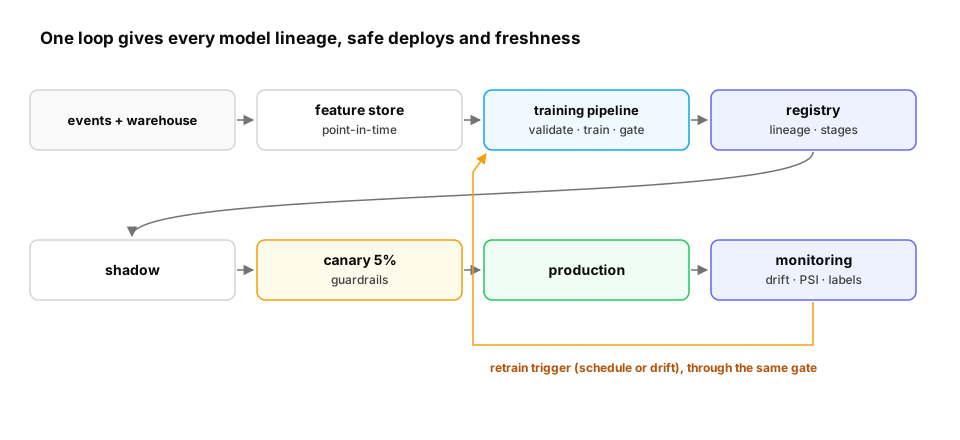
the platform loop: event stream and warehouse → feature store (offline point-in-time tables, online low-latency store, one definition) → orchestrated training pipeline (data validation → train → evaluate against the champion → register with lineage) → model registry (staging → canary → production) → serving with shadow and canary traffic → monitoring (data drift, prediction drift, delayed-label performance) → retraining trigger back to the pipeline.
Diagram— the platform loop: event stream and warehouse → feature store (offline point-in-time tables, online low-latency store, one definition) → orchestrated training pipeline (data validation → train → evaluate against the champion → register with lineage) → model registry (staging → canary → production) → serving with shadow and canary traffic → monitoring (data drift, prediction drift, delayed-label performance) → retraining trigger back to the pipeline.

You already know: the ML lifecycle, pipelines, platform tools, feature stores, deployment strategies and monitoring (D11 lessons 1–6); point-in-time joins (SQL for ML); evaluation gates (D10).

Why this matters for Atlas. Each piece of D11 solves one problem; a platform makes them work together so that every model gets the same guarantees for free: reproducibility (any model can be rebuilt from its code, data and config versions), safe deployment (shadow, canary, automatic rollback), observability (drift and performance monitored per model and segment), and freshness (retraining when data or performance says so, through the same gated pipeline). This capstone builds a miniature version of each component in Python and runs a model through its whole life, including a drift event.


1. Lineage: every model traceable to code, data and config

The question. Six months from now, can you rebuild exactly the model that made yesterday's predictions?

Start from nothing. Give every artefact a content hash and record what produced it: dataset versions (hash of the data snapshot or the table version), feature definitions, code commit, config and seed, and the metrics at registration. The registry stores models with this lineage and a stage (staging, canary, production, archived); deployment always references a registry version, never a file path. Promotion requires the candidate to beat the current champion on the evaluation gate.

That's the preview. The full lesson, with its code and exercises, is part of Unrolled Pro.
Staff AI & Pro Tier Lesson

Unlock "Capstone: An End-to-End ML Platform — From Raw Events to Monitored, Self-Refreshing Models"

The foundations are free forever. Unrolled Pro unlocks the complete lesson, production architectures, and 55 battle-tested ML system design case studies.

Everything included with Pro:
All 234+ Deep-Dive Lessons across transformer internals, inference, RAG & agents
55 Staff-Level ML & System Design Case Studies with mathematical capacity estimates
AI Engineer Sheet & Exercises with worked solutions, self-checks, and code
100 Landmark Research Papers guided walkthroughs & progress tracking
14-Day Money-Back Guarantee — 100% full refund if you aren't satisfied
View Plans & Unlock All Lessons

From ₹167/mo (~$2/mo) · Cancel anytime · Instant activation

100% Risk-Free: 14-day no-questions-asked money-back guarantee